Showing posts with label Eastern Yellow Robin. Show all posts

Thursday, May 9, 2013

CAPERTEE REDUX


The last time I published a post about the Capertee Valley, I concentrated on our sighting of the critically endangered Regent Honeyeater:  http://qldbirder.blogspot.com.au/2012/11/capertee-revisited.html
This time I've included a varied selection of other images from our visit.


The cliffs of Wollemi National Park


Being Spring there was a fair bit of activity around the place, which made for some nice birding and great photo opportunities. The Bellbirds were in full "tinking" mode, and though usually fairly high up in the gums this one came down for a better look at the intruder.


Bell Miner


This male fairy-wren was in fully breeding regalia, and although the photo doesn't do it justice, the bright blue head shone out like a flourescent beacon in the dull evening light.


Variegated Fairy-wren


Beside the Capertee River, in Wollemi National Park, from the concealment of my car I was able to film a Superb Lyrebird foraging along the bank, casual as you please. Later he took some time out to do a spot of bathing, and I felt privileged to get a glimpse into his daily routine. 


Superb Lyre-bird - male 


This raptor was eyeing off  potential prey from a convenient fence post beside the road.


Brown Falcon


A couple of masurpials were out and about too.


Swamp Wallaby or Stinker


Eastern Grey Kangaroo - male


And a monotreme that became camera shy. It's very difficult to sneak up on these unique little creatures. 


Echidna


While exploring the rocky escarpment behind the camping area at Glen Davis I was able to observe a pair of Rock Warblers going about their daily routine. 


Rock Warbler


The ubiquitous Eastern Yellow Robins were as usual photogenic. One of my favourite bush birds.


Eastern Yellow Robin


I couldn't quite capture the rufous coloured rump on the Songlark.


Rufous Songlark


The Babblers were active at their communal nest near our campsite, just on dusk. 


White-browed Babbler


Capertee River


Cheers & Happy Birding


Tuesday, April 17, 2012

GLOUCESTER TOPS AND PURPLE ROOS.


Continuing on our journey along the Great Divide we headed for Gloucester Tops, part of the Barrington Tops National Park west of Taree NSW. On the drive up to the van park we spotted three Glossies in the she-oaks beside the road and I was able to get a shot of this female before they moved on.

Glossy Black-Cockatoo

Once we were settled in to our digs near the National Park entrance we drove the rough dirt road to the top of the range stopping often to enjoy the views and listen out for the Rufous Scrub-bird. We saw something scuttling across the road but it was too brief to identify.

Gloucester Tops

After 4 hours of walking the tracks and searching we heard five different birds at five different locations but not a glimpse. I tried callback a couple of times and had one within a couple of metres. Heard only but no tick.Very frustrating! But the beauty of the area more then made up for it.


The wildlife around the van park was a lot more accommodating than the Scrub-birds.

Red-necked Wallaby

The Superb Fairy-wrens have been constant companions on our journey to date, they are always a welcome sight and inquisitive to boot (or thong). They have become our official mascot!

Superb Fairy-wren (female) 


Bird on a thong

And another bird that doesn't mind having us around the neighbourhood.

Eastern Yellow Robin

The morning of our departure I walked one of the trails and spotted a large bird scratching through the undergrowth. My first Superb Lyre-bird ever, a pretty exciting moment as it perched on a low branch and started to serenade me. The song didn't seem to have much in the way of mimicry in it, maybe it was telling me to go away! Hopefully I'll get to see a mature male one day. The picture is crap but being a lifer I had to post it.
Another highlight, the day before, was seeing the jewel of the rainforest, a Noisy Pitta, close to the limits of it's southerly range.    


Superb Lyrebird ( Female or immature)


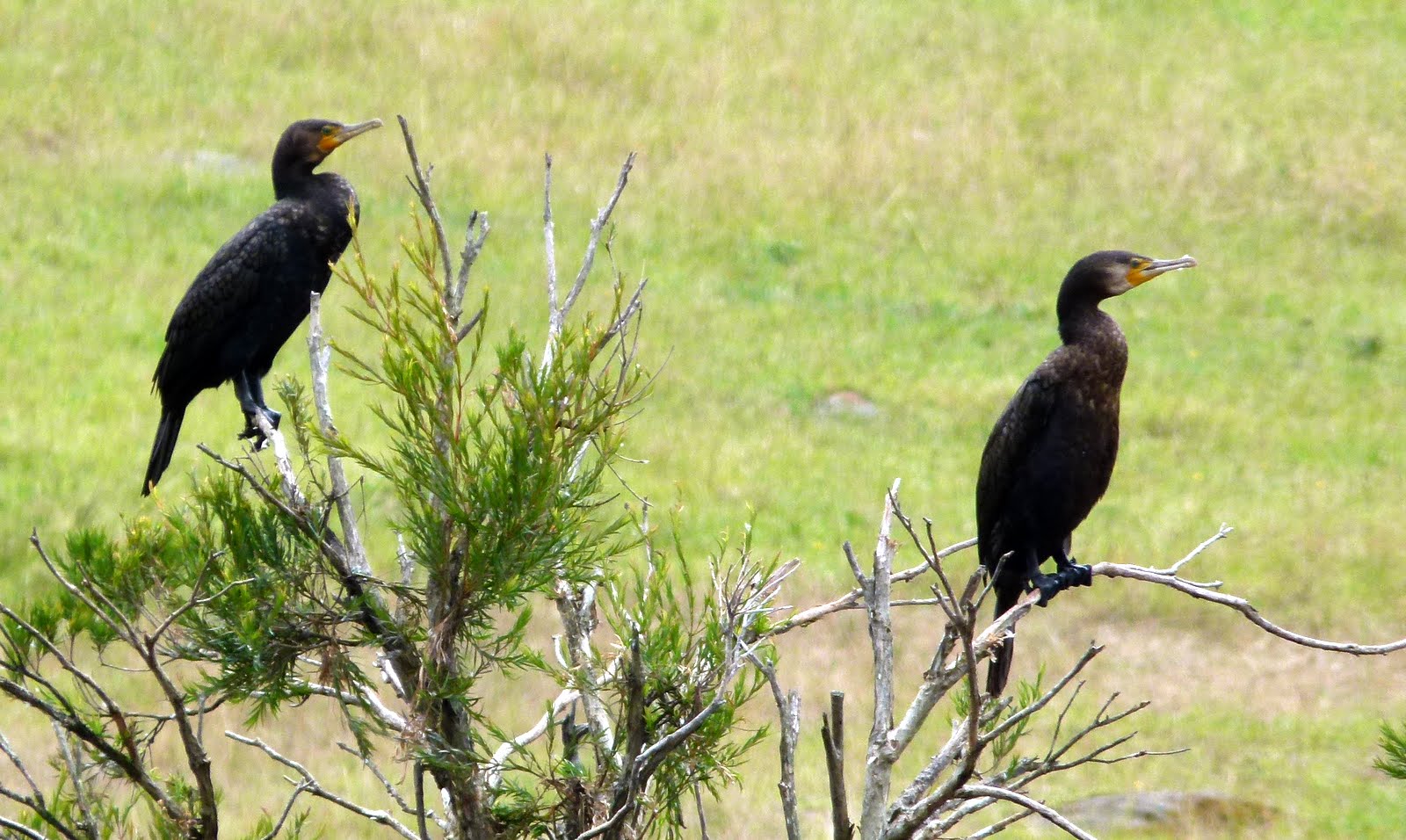
After Gloucester we based ourselves at Cessnock and spent a day out touring some wineries in the Hunter Valley. Not much birding but these two caught my eye in between vineyards.

Great Cormorants

And these specimens were the only known members of the critically endangered sub-species of the Eastern Grey Kangaroo, the Purple Kangaroo found only at this particular location in the Hunter. 


Macropus Giganteus Purpelius

They were actually part of the annual Sculptures in the Vineyards promotion that was happening at the time and most were up for sale. We would have purchased the roos except we don't have a yard to place them in at the moment!


Tuesday, December 20, 2011

PIPERS, PARROTS AND PIGEONS.


This robin is one of my favourite birds and we have one that inhabits the scrub in our backyard.
I call it the piper at the gates of dawn*, being the first one to start off the morning chorus.
It's also usually the last bird to call in the evening.     

Eastern Yellow Robin

Some fresh seed in the feeder brought in a couple of unusual visitors, a pair of King Parrots, which I've only seen fly over our place occasionally. These two weren't shy and I assume they may have utilized some other feeders in the neighbourhood. 

Australian King Parrots - males.


Another bird to drop in for the first time a few days later was this large pigeon. The news must be getting around that there's a free feed at the our place!

White-headed Pigeon

These are normally a shy, rain-forest dwelling, fruit eating species and it may be the case that these birds have also become more confiding around human habitation, especially with the destruction of their natural habitat and their reliance on the introduced Camphor Laurel tree.


This cousin of the above mentioned bird was spotted by Clare sitting on the roof of our van out front.
A beautiful, pure white racing (or feral) pigeon that on closer inspection was bleeding from wounds in it's breast and rump. Maybe a raptor attack? We have three species of Goshawks on our backyard list.A distinct possibility! But most probably a Peregrine Falcon, the bane of pigeon fanciers worldwide.   


This was one lucky bird and in an attempted rescue operation it flew off when I tried to throw a towel over it. It took off strongly and disappeared into the distance hopefully to survive another day. 


The culprit may have been one of these magnificent killers, a Brown Goshawk. This one I saw recently at the Cooroy wetlands scaring the wits out of the nearby feathered inhabitants.

Brown Goshawk - female.

This bird was also spotted at the wetlands, singing for all its worth and obviously not too worried about killer raptors!

Olive-backed Oriole