Showing posts with label Welcome Swallow. Show all posts

Monday, November 17, 2014

MOUNT WELLINGTON, TASMANIA


For a few weeks in the summer of  2012/13 we were based near Hobart, in our van in the backyard of my brother and his partners place at Droughty Point. The back deck of the house overlooks Ralphs Bay, a great place to unwind after sampling the scenic delights and birding opportunities of the area.


Ralphs Bay


While relaxing on the aforementioned deck we were entertained by the local swallows, which came in to rest on the railing in between their graceful insect chasing flights.


Welcome Swallow


One of the more common introduced birds in Tasmania was prevalent around the house too. 


European Goldfinch


No visit to Hobart is complete without a drive up to the summit of Mount Wellington, which at 1271 metres towers above the city and makes for one of the most outstanding viewing points in any of our capitals here in Australia.


Tasman Bridge and Derwent River


It also makes for a stunning back drop to the city, but for some reason I failed to take a snap of this brooding giant on Hobart's doorstep, on this trip. I have included an image from a brief visit a few years back, when the mountain was dusted in a light covering of autumn snow.


Mount Wellington - April 2009


With numerous walking tracks through varying habitats from temperate rainforest to alpine wilderness, the mountain is a bush walkers paradise. 


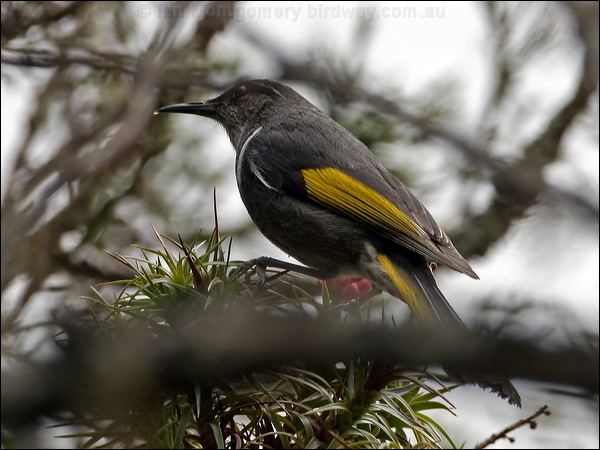
Flowering shrubs were in colourful profusion and as we wandered along one of the tracks we were greeted by the high pitched calls of Crescent Honeyeaters. These birds breed in the high country in summer and disperse to lower areas in the cooler months.  

Image below courtesy of Ian Montgomery at: http://birdway.com.au/index.htm


Crescent Honeyeater


The wildflower display was the highlight of our visit to the summit and combined with the breathtaking views gave us a very memorable experience.


Kerosene Bush


Mountain Pinkberry


Tasmanian Waratah


Wiry Bauera and Alpine Heath


Silky Pimelea


Most of Tasmania's twelve endemic bird species can be found within the reserve known as Wellington Park, with two of the more conspicuous ones pictured below. 


Black Currawong


The currawong is also an altitudinal migrant and the wattlebird at up to 45 centimetres in length, is the largest of the Australian honeyeaters


Yellow Wattlebird


I was able to snaffle all the endemics during our ten week sojourn and also pick up some specialities like Swift Parrot, Pink Robin, Beautiful Firetail and Forest Raven. The bird life, except for some of the more common species, is not particularly prolific and some of the smaller bush birds like the Scrubtit and the endangered Forty-spotted Pardalote can be difficult to locate. But patience and time usually bring about some very rewarding birding experiences.


If the wildlife is a bit thin on the ground, there is always more incredible scenery to contemplate.   


The Organ Pipes


This rock climber was taking his viewing experience a little more seriously than most!


View to South West Wilderness from summit.


Hobart and suburbs


Not long after we departed there were some massive and destructive bush fires to the east of my brothers property, and although they weren't directly affected, some wind changes brought smoke and ash to their vicinity.  


Ralphs Bay, 4/1/13  (photo by Jo Burke)


An indispensable publication for exploring Tassie and a great companion to the field and "where to find bird" guides is "Where to See Wildlife in Tasmania" by Dave Watts & Cathy Plowman. Highly recommended!


Cheers & Happy Birding


Tuesday, November 26, 2013

HORROCKS BUSH BIRDS


A selection of photos of some of the birds that live in the patchy bushland and coastal scrub around Horrocks WA, where we are currently living and working. I have compiled a list of over 80 species within a 5 km radius of the town, of which well over half have been observed in the aforementioned habitats, with many of these around the caravan park.


View of Horrocks from escarpment with caravan park at centre


A pair of Little Eagles perch in the gums in the van park occasionally, but are generally seen soaring along the edge of the limestone escarpment behind town. Nine species of raptor frequent the area, so there's plenty of tucker around, including the wild rabbits that we sometimes see scampering off into the scrub. 


Little Eagle


A pair of Kingfishers are making their presence known with their monotonous contact calls and swift, direct flights to pick up prey from the ground.


Sacred Kingfisher


Tree Martins abound with many nesting in under the eaves of some of the holiday houses, although tree hollows would be their natural preference. They also like to feed along the shoreline, a joy to watch with their aerial antics.


Tree Martins


The one below was taking advantage of a sprinkler to cool off a bit.  

Tree Martin


Conversely these swallows were welcoming the midday sun along the back of a shed. I have seen this "sunning" behavior before in other birds such as doves and magpies and of course cormorants.  
An interesting article on this phenomenon here:  http://birdlife.org.au/australian-birdlife/detail/sunny-side-up


Welcome Swallow


I've noticed a distinct lack of  parrots and cockatoos, with only two species prevalent here, Australian Ringneck, with a small group around the van park and the sporadic flocks of Galahs flying by. Probably because of the paucity of nesting hollows, with much of the native vegetation long ago removed for wheat and sheep farming.


Australian Ringneck


A very common, introduced species around the park and surrounding coastal scrub is the Laughing Dove with its somnolent chuckling call, a lovely sound that can put you in the mood for an afternoon nap.


Laughing Doves


Singing Honeyeaters are constantly on the move, and like many of their family do not need to rely solely on flowering plants to get by, with insects making up a large part of their diets.  


Singing Honeyeater


Their feisty cousins the White-plumed Honeyeaters rule the roost in the park, with this specimen one of a number of young birds constantly begging to be fed.


I was pleased to come across a lifer while exploring some thick creek side scrub, one of the Petroicidae family, and this one being unique to Western Australia. It was quite shy compared to it's relative and one of my favourites, the Eastern Yellow Robin. As we continue our travels early next year I hope to find a few more endemics in the south west of this huge state, including the Western Yellow Robin.  


White-breasted Robin


While checking out some Aboriginal rock art at Willy Gully caves, we spotted this Pardalote using an abandoned Fairy Martins mud nest to rear its own young. 


Striated Pardalote


Willy Gully Caves rock art


A couple of Fairy-wren species also utilize the abundant coastal vegetation around Horrocks with the White-winged version preferring the low lying, salt tolerant plants closer to the beach.   


White-winged Fairy-wren - male


And the Variegated liking the taller, thicker scrub along the dunes and escarpment.


Variegated Fairy-wren - female


A link here to a previous post on my experiences with these beautiful little birds in WA:


Cheers and Happy Birding


Wednesday, March 20, 2013

NORTHWEST NSW


Travelling east from Brewarrina, over the next couple of weeks we visited various areas while enjoying the spectacular winter weather. These honeyeaters were basking in the sun next to our van at Lightning Ridge.


Blue-faced Honeyeaters


As were this pair of swallows on our washing line, while staying near the farming community of Burren Junction. 
This small town is renowned in the Aussie birding world as the temporary home of a vagrant wader from Asia in 2006, a Grey-Headed Lapwing. I twitched it with three friends, along with probably hundreds of others in the four months it stayed. This record was a first for Australia and possibly the Southern Hemisphere.


Welcome Swallows 


Nothing quite as exciting this time around, although the sunsets were quite impressive.


Sunset at Burren Junction


It also boasts a top free camping site and bore baths with hot water direct from the Great Artesian Basin. Very nice on a cool winters day!


From Narrabri we explored the nearby Nandewar Ranges, the remnants of an ancient basaltic shield volcano, with Mt Kaputar being the highest point.


Red Wattlebird


Mt Kaputar- 1508 metres 


Australian Raven


One of the more spectacular sights was the forty metre high Sawn Rocks, a wall of pentagonal basalt pipes, the remains of a lava flow from the old volcano.


Sawn Rocks


Looking for raptors


The canola crops were flowering under the winter sun and made for a colourful foreground to the rugged ranges.


Nandewar Ranges


Cheers & Happy Birding